
UWR Revenue, who is paying for the wildlife I watch?
“If not for all the Buffalo hunters, there would be no Buffalo”
Abigail Edwards
I have been a wildlife watching enthusiast since I was a tiny little
kid. When I was barely old enough to watch for alligators, my father
would take me into the backcountry of Everglades National Park and
teach me to appreciate the critters that thrived in the wildlands.
We visited all the improved trails, boardwalks, and facilities
dozens of times. We frequently day hiked on our own in the pine
flatwoods and tropical hammocks. We made week-long camping trips
canoeing through the mangrove forests and the sawgrass prairies. All
the while, we were surrounded by a menagerie of incredible animals
that coexisted in the natural environment.
For as long as I can remember, I have endured listening to the
sportsman's creed; hunters and anglers emphatically explain that
wildlife watching is only possible because the hunters and anglers
banded together and saved the animals from disappearing. The fees
levied on hunters and anglers underwrite the conservation programs
intended to keep wildlife from going extinct. Without hunters, there
would be no wildlife, or so we are led to believe.
One of the most common ideas put forth is the claim that taxes
levied on hunters and anglers pay for all the land acquired to
become designated as Wildlife "Management" Areas, a narcissistic
euphemism, or U.S. Wildlife "Refuges", a perverse euphemism to
consider while waterfowl and game hunts are being waged upon our
nation's "refuges". In this great country, with its massive domestic
economy, citizens are told that we have been wholly dependent on a
harvest tradition to underwrite the preservation of the publicly
owned landscapes that wildlife can make use of.
This myth becomes most egregious and self-serving when the
wildlife-watching public is described as free-loading off the
efforts of those who pay to support the system of management and,
here's another handy euphemism, "conservation". Politicians
callously claim that participants entering managed areas for
wildlife watching, exercise, or casual entertainment are not paying
their fair share. Politicians want to increase their tax revenues to
offset the impact of watching some birds or walking through the
woods. Hunters and Anglers are methodically groomed to actually
believe the public is taking advantage of them. A quick survey of
any hunting social media discussions of the subject will confirm the
vehemence targeted at those who enter managed areas without paying
for the right to leave with a bloodied caucus.
Here are some examples. In the public forum Community Area of
UtahWildlife.net
the user Goose wrote "...It’s about time freeloaders quit riding on
hunters dollars..." which elicited this reply from user one4fishing
"... no one that doesn’t hunt realizes that license fees pay for
those areas..." who goes on to write "...We as sportsmen need to do
a better job of helping non consumptive users understand that we
foot the bill for conservation. ..." The certitude with which these
claims are made is appreciable, but are any of these ideas actually
true?
Clarity can be found by looking at data published by governmental
agencies. For example, the Utah Division of Wildlife Resources
publishes reports of its revenue and expenses. So, I took a look at
the
UWR Fiscal Year 2025 financial information report
to establish some perspective on the facts.
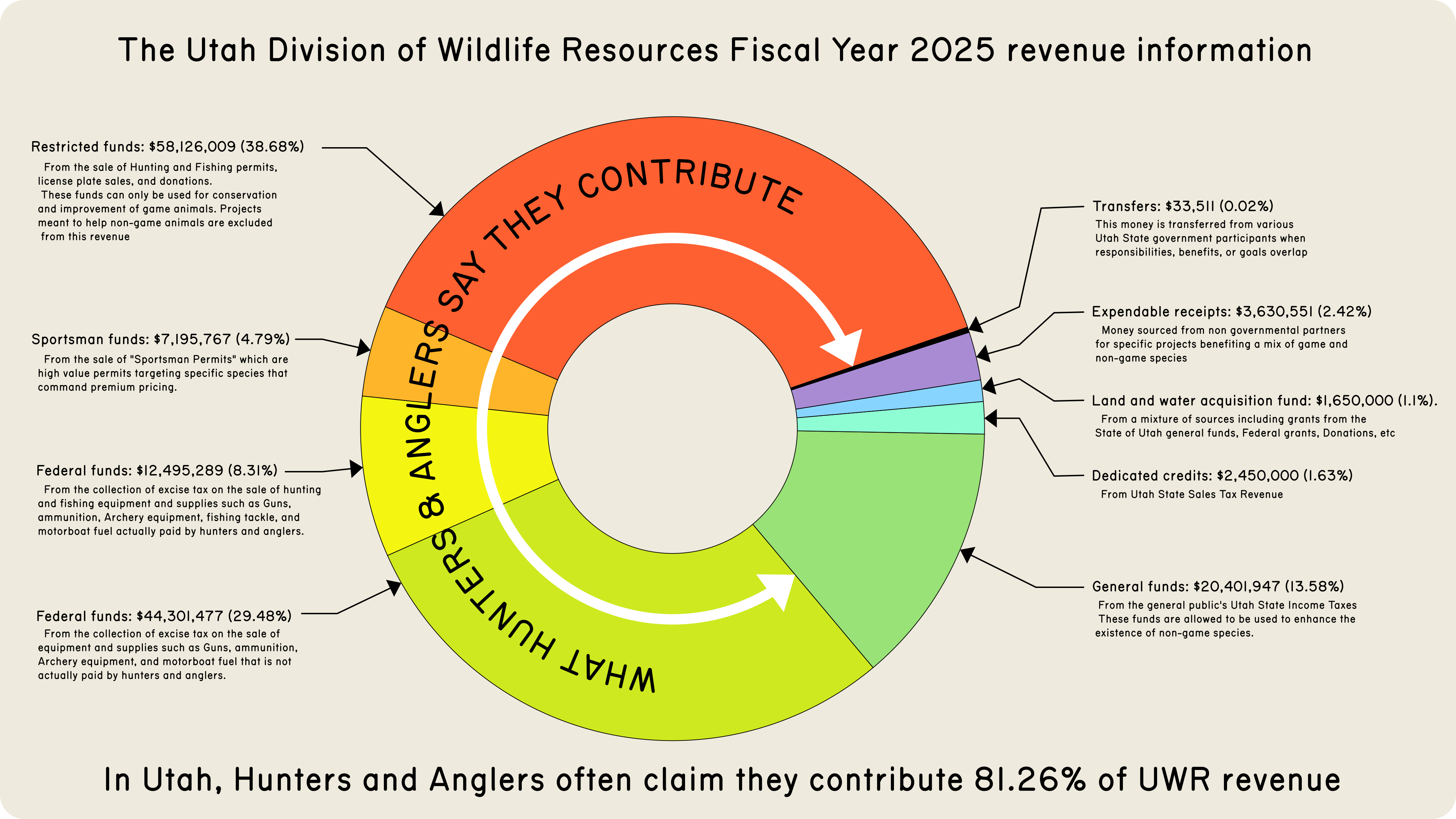
Here is the breakdown published in the report:
- Restricted funds: $58,126,009 (36.68%)
- from the sale of state hunting and fishing licenses.
- Sportsman funds: $7,195,767 (4.79%)
- from the sale of special hunting permits.
- Federal funds: $56,796,766 (37.79%)
- from the federal excise tax on hunting and angling equipment.
- General funds: $20,401,947 (13.58%)
- from the Utah general population via the state income tax.
- Dedicated credits: $2,450,000 (1.63%)
- from the Utah general population via the state sales tax.
- Land and Water acquisition: $1,650,000 (1.1%)
- from grants and donations sourced from various parties.
- Expendable receipts: $3,630,551 (2.42%)
- from special interest partner grants or donations.
- Transfers: $33,511 (0.02%)
- from other state government who share an interest.
These annual reports are very informative. They helpfully explain
where the revenue comes from and how it is spent. I believe the
division operates in good faith, but I noted a few statements that
warrant skepticism.
For example, the subtitle of the report states "The DWR's main
revenue source is from license and permit sales", which could be
accurate, or not, depending on how you parse the meaning of the word
"Main". Elsewhere in the descriptive paragraphs, the following is
boldly stated as an article of fact: "The majority of DWR's revenue
is generated from the sale of hunting and fishing licenses and
permits." This statement is false.
Let's look at these two statements and compare them to the data
published in the same report. The license and permit fee revenue
received by the DWR is represented by the Restricted Fund and the
Sportsman Fund. The first accounts for 38.68% of the UWR budget, and
the second amounts to 4.78%, for a grand total of 43.47%.
43.47% is not the majority of the budget, but this bold statement
validates those who will repeat the myth without question. To be
fair, the 38.68% attributed to the Restricted Fund is the largest
single, or perhaps "main" category. So, for what it's worth, there's
that.
An important qualifier needs to be acknowledged and should be
understood by those who do not hunt or fish. This 43.47% of the
budget can only be used to further the management of game species.
In Utah, there are several dozen animal species that people get to
kill as game.
The $65,321,776 collected from license and permit fees can only
be spent on programs that directly effect the game populations
that hunters and anglers want to kill.
If any one of the hundreds of other animal or plant species that
live in Utah receive a corollary benefit, that is just a lucky
happen chance.
In other words, the Red-tailed Hawk you might be marveling at is not
being protected by the license and permit fees hunters and anglers
have contributed. The Hawk's meager protections are funded by other
sources of revenue. Keep that in mind the next time you encounter
the myth.
The UWR revenue also includes a large category of Federal Funds
primarily sourced from excise taxation on the sale of firearms,
ammunition, archery equipment, fishing tackle, and motorboat fuel.
The Federal funds amount to $56,796,766 or 37.79% of the budget.
When added to the Restricted Fund and the Sportsman Fund, the total
appears to be $122,118,542 or 81.26% of the UWR budget. That's an
impressive percentage, and this is why most hunters and anglers
believe they are footing the bill for everyone else.
Federal Funds
The excise tax is not what it seems
Upon further consideration, it becomes apparent that the Federal
Funds, collected as excise taxes established by the
Pittman-Robertson Wildlife Restoration Act and the Dingell-Johnson
Sport Fish Restoration Act, are not exclusively paid by hunters and
anglers. In fact, federal reports suggest that 78% of the federal
excise tax collected is paid by users who do not hunt or fish.
Approximately 75% of this federal excise revenue is collected from
firearm and ammunition sales, with the majority of those items
purchased by target-range shooters, self-defense practitioners, or
end-times hoarders. It turns out that hunters don't use as nearly
many bullets as folks who frequent the range to empty a few clips
for fun and excitement.
The remaining portion of tax revenue is attributed to anglers.
Fishing tackle sales are self-defining but relatively low in overall
value, while the tax on motorboat fuel is predominantly paid by
pleasure boaters who are just cruising the waterways rather than
fishing. Note that commercial fishermen are exempt from the fuel
tax.
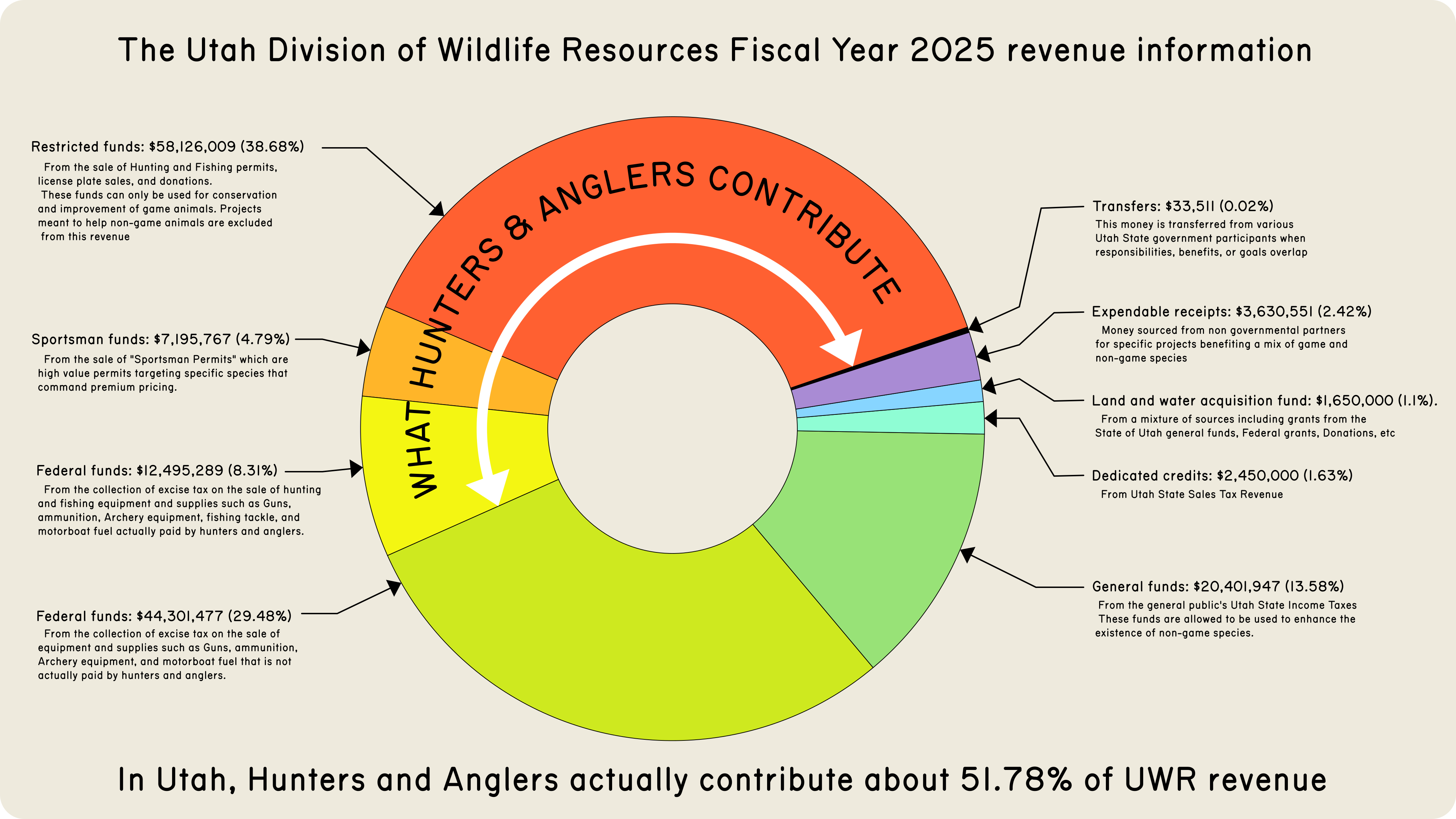
The 22% of the Federal Fund paid by hunters and anglers equates to
$12,495,289, while the 78% of the Federal Fund paid by the general
population equates to $44,301,477.
So, if you subdivide the Federal Funds appropriately, you have a
more accurate representation of how much the hunters and anglers are
paying into the system.
The hunters and anglers are directly contributing $77,817,065 or
51.78% of the UWR revenue.
Not just the sporting few
I already pay to view wildlife, and you do too
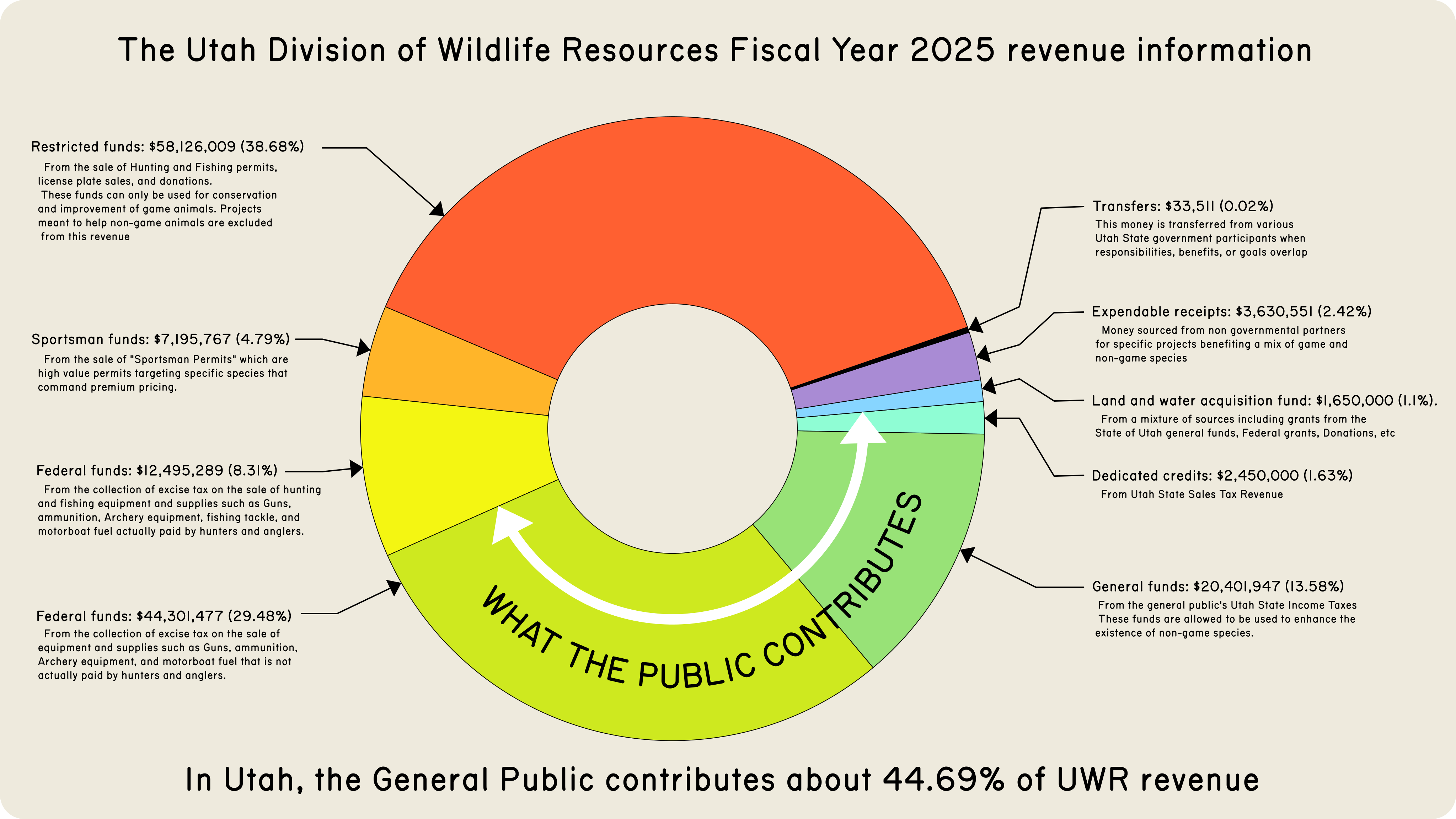
The Utah UWR $20,401,947 General Fund is sourced from state income
tax. While a small percentage of citizens hunt and fish, and
contribute to this fund, this is money collected from everybody and
meant to be spent to serve everybody. The $2.45 million Dedicated
Fund is sourced from Utah sales tax and is a tiny portion of the
$13.79 billion Utah sales tax collected in 2024.
Together, these general-purpose Utah taxes amount to $22,851,947 or
15.21% of the UWR revenue. When you add this to the $44,301,477
portion of the Federal Fund paid by the average citizen you realize
a substantial figure of $67,153,424, which is 44.69% of the total
revenue.
The hunters and anglers directly contribute about 52 percent of the
UWR revenue, but do so in exchange for the right to take something
of tangible value from the environment and bring it home as a prize.
The general public contributes 44 percent for the privilege of
leaving only footprints and taking only pictures.
That's not all of it
A small portion varies year to year
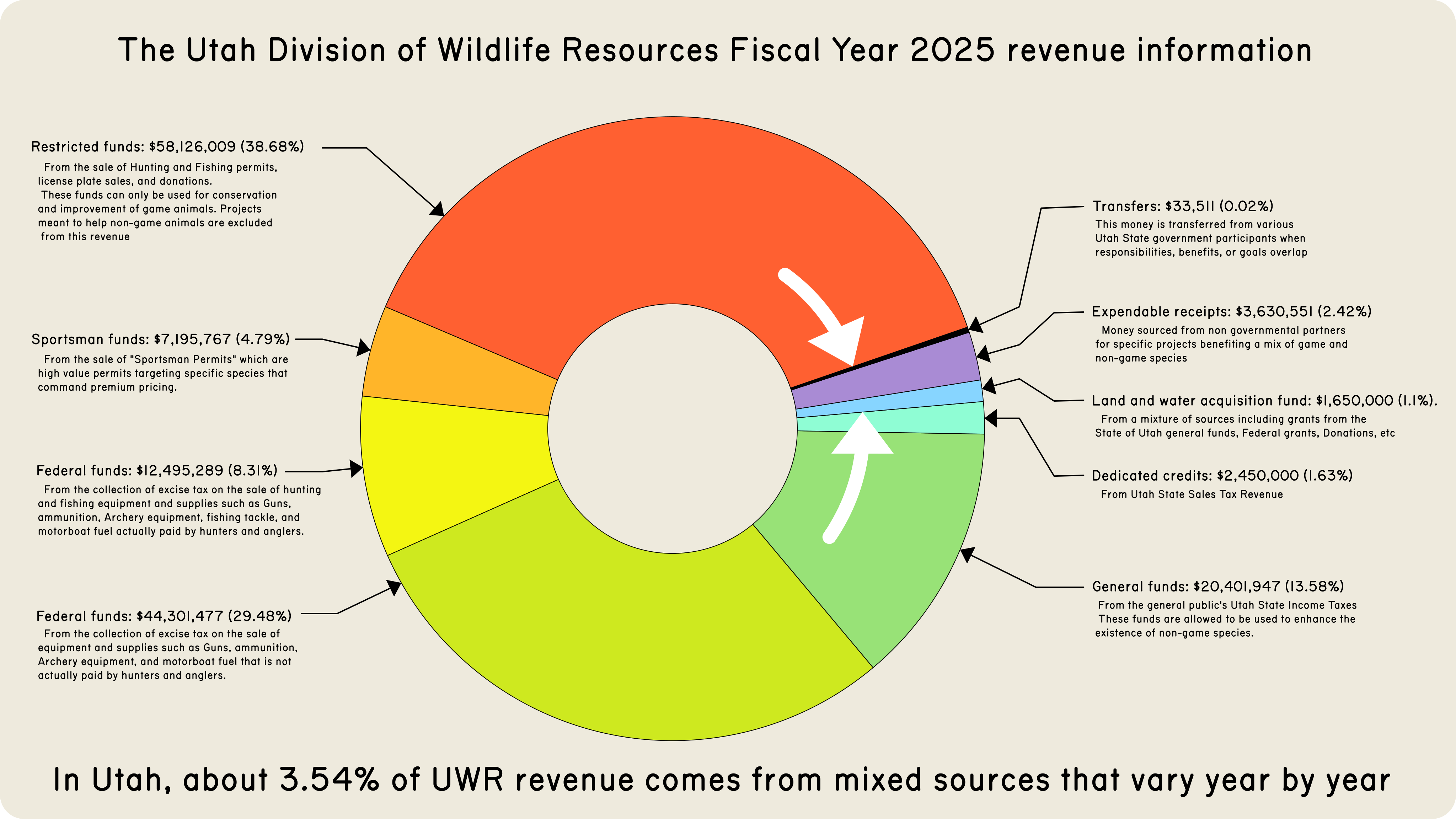
The remaining 4 percent of the revenue is paid by sources that vary
year to year. There might be a donation to a special project made by
the Audubon Society. There might be another project funded by a
contribution from the Hunters of America. It varies too much to
generalize.
Who pays for the land?
A needle in the haystack
What about the land? I have been told time and time again that
Hunters paid for the purchase of the Wildlife Management Areas. A
quick look at the revenue report shows that only 1.1% of revenue is
devoted to acquiring WMA land. That $1,650,000 pales in comparison
to the $77,817,065 paid by hunters and anglers or the $67,153,424
paid by the general public. Furthermore, the Land Acquisition Fund
is sourced from donations or grants from State and Federal funds,
not from hunting or fishing licenses or permits.
The facts are that the Utah Division of Wildlife Resources collects
and spends most of its money to ensure that hunters and anglers
don't eradicate a species and cause extinction. Its primary expense
is making sure hunters and anglers do not run out of living
creatures to kill. That's it.
Finger-pointing at wildlife watchers, hikers, joggers, bicyclists,
kayakers, canoeists, and dirt road drivers with tha accusation that
we need to pay a fair share is nothing more than a money grab by a
bureaucratic behemoth that has been assembled to prevent a complete
loss of subjects to kill. History has shown us that, left unchecked,
hunters and anglers have brought the species they covet to the brink
of extinction time and time again. The Utah Division of Wildlife
Resources exists to protect the hunters and anglers from the
misdeeds of hunters and anglers.
Innocent bystanders who rejoice at the chance to watch wildlife
living free in a wild habitat are not the problem, yet we do
contribute significant funds to ensure there is some wildlife left
for us to be enraptured with.
Those of us who merely visit a wildlife management area with an
interest in viewing wildlife or experiencing a natural habitat have
paid for the privilege many times over. The hunters and anglers have
been killing everyone's shared wildlife resource while we have been
subsidizing the consumption. It is time for hunters and anglers to
stop spreading the myth that they have been the solution to the
problem.
Hunters and anglers have disrupted the natural order by using
advanced machinery and sophisticated tools to prey on the most vital
examples of our wildlife population. They leverage an overwhelming
technical advantage while seeking the prizes they refer to as
trophies. These people are systematically weakening the stock by
leaving the less vital members to serve as the progenitors of the
future's wildlife population.
The hunters and anglers operate in direct contradiction to the rules
of nature, whereby weakened individuals were preferentially targeted
by subsistence predators and culled from the population in a system
where the most vital members survived to strengthen the overall
health of subsequent generations.
The bureaucracy of the UWR substitutes selection biased science,
man-made quotas, and dubious trial-and-error methodologies described
as "wildlife management" to offset the hunters' and anglers'
disruption of the ancient laws of nature.
Layer upon layer of administrators and well meaning scientists are
funded to distract us from the obvious fact: wildlife does not need
to be managed. The collective of flora and fauna was doing a pretty
good before certain parties tried to take everything they good get
their hands on. If wildlife is left unmolested, wildlife finds a way
to make the best of its circumstance.
Would the general population need all of the UWR services if the
animals were simply left to live without the impacts of recreational
slaughter?
Habitat protection is valued by all wildlife enthusiasts. Yes, it
costs money to protect habitat from degradation but only a small
portion of UWR's annual budget is devoted to that purpose.
Science that recognizes debilitating externalities, such as
pollution or habitat encroachment, is important to all wildlife
enthusiasts. The general population is paying a good amount of money
in the hopes that such science is put to good use.
Politicians in Utah, who have been goaded on by hunters and anglers,
have made recent attempts to exact extra taxing revenue from
no-impact and low-impact visitors of wildlife management areas.
These money grabs are abhorrent. Why should a bird watcher pay extra
to support a bloated bureaucracy dedicated to keeping hunters and
anglers from rendering their blood sports extinct?
Further taxation for something we already pay for, that primarily
supports an activity most of us do not want to participate in, feels
like a knife being shoved in our guts and then twisted just to see
how much we are willing to take before voicing disagreement. If
someone thinks there should be a birdwatchers tax just to make it
fair for "everyone", I will disagree.
Contact info:
This website is copyright 1998-2025 by Mike McCue Moab Utah USA